Mimulus lewisii “Purple Monkeyflower” Phrymaceae (Scrophulariaceae)

Great Burn, Lolo National Forest, MT
July 10, 2015
Robert Niese

This species of monkeyflower was named after the naturalist and explorer, Meriwether Lewis (of Lewis and Clark), who discovered it in Montana, at the headwaters of the Missouri River. Although Lewis was not formally trained as a botanist, he collected and described hundreds of plant species, many of which were completely new to science at the time. Specimens of this particular plant, however, were lost in a flood and never made it back to Washington DC where they would have been cataloged, named, and formally described by Frederick Pursh. Instead, using only Lewis’s descriptions in his journal, Pursh was able to define this plant as a new species!

Spiraea densiflora (splendens) “Subalpine Spiraea” Rosaceae

Great Burn, Lolo National Forest, MT
July 10, 2015
Robert Niese


This species of Spiraea is a popular garden plant thanks to beautiful, fragrant pom-pom inflorescences. In the wild, it commonly inhabits moist, rocky slopes throughout the PNW. If you’d like to propagate your own, check out these instructions for collecting and germinating seeds.

Mentha arvensis “Wild Mint” Lamiaceae

Missoula, MT
July 19, 2015
Robert Niese

Mint is one of the most abundant, easily recognizable plants growing along the banks of Missoula’s rivers this summer – perfect for those on-the-fly, riverside mojitos! Look for its square stems, axillary flowers, and minty aroma!

Chamerion (Epilobium) angustifolium “Fireweed” Onagraceae

Great Burn, Lolo National Forest, MT
July 10, 2015
Robert Niese


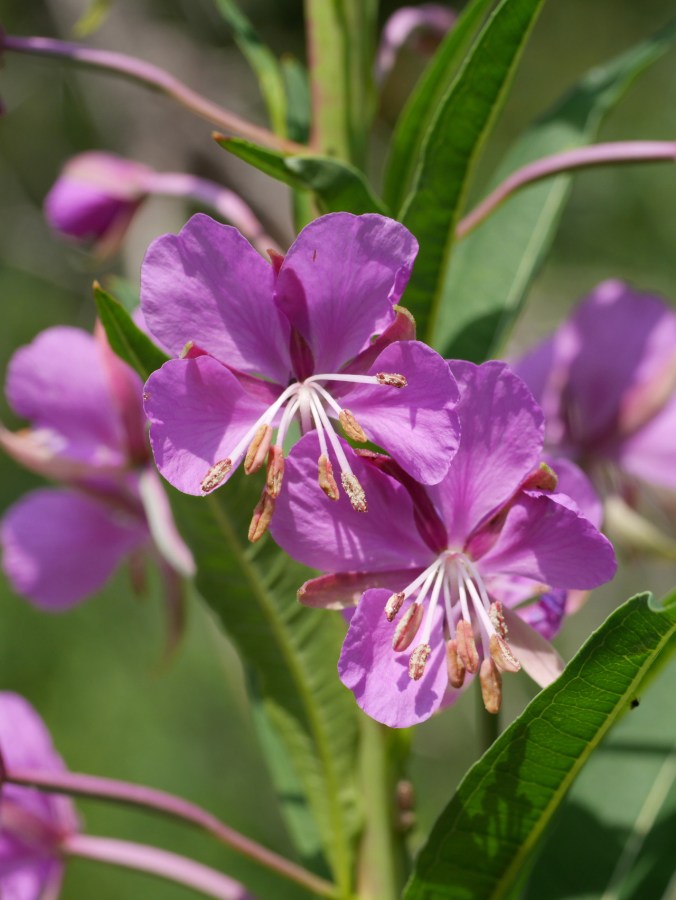
Unlike its name suggests, Fireweed is hardly a weed! One of the PNW’s most abundant wildflowers, Fireweed holds an important role in nearly every native culture. Its young shoots and leaves are a delicacy to some, and medicinally important to others. Many peoples used fibers torn from its shoots to make rope, and, still today, folks throughout the northern hemisphere use its fluffy seeds as a natural stuffing for pillows.

Ribes cereum “Wax Currant” Grossulariaceae

Missoula, MT
July 19, 2015
Robert Niese

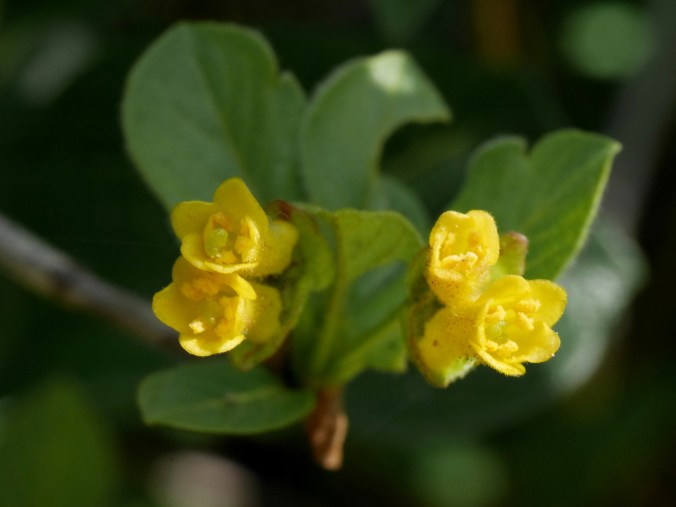
Apparently the berries of the Wax Currant are not very palatable. In fact, its young leaves and flowers are a much more prized trailside treat than its fruits! These little berries will retain their characteristically long, shriveled flowers to maturity when they start to turn red. Perhaps I’ll collect some for a wildberry jam later this summer.

Rudbeckia occidentalis “Western Coneflower” Asteraceae

Great Burn, Lolo National Forest, MT
July 10, 2015
Robert Niese

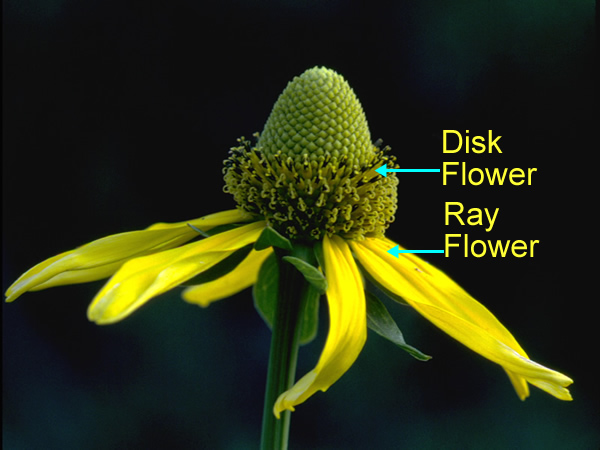
While most coneflowers that are grown in gardens tend to have showy, petal-like ray flowers, these PNW endemics have only disc flowers. The Western Coneflower is an uncommon resident of moist meadows and valleys in the Northwest and has a very scattered distribution throughout our region. When you do stumble across a population of them, however, they tend to be in great abundance. During our weekend of backpacking in the Bitterroots, these flowers were only just beginning to bloom, and I suspect that most will be done blooming within the week.

Cornus canadensis “Canadian Bunchberry” Cornaceae

Weir Hot Springs, Clearwater National Forest, ID
June 8, 2015
Robert Niese

Bunchberry is another member of the genus Cornus, but unlike its shrubby cousins, C. sericea and C. nuttallii, this species rarely grows more than a few inches from the ground. And unlike C. sericea, bunchberry flowers are minute, inconspicuous, and subtended by large, white bracts which are often mistaken for petals. It shares this type of inflorescence with the Pacific Dogwood, C. nuttallii. The fruits of the bunchberry, while not particularly tasty, are high in pectin and are often added to jams and puddings.

Cornus sericea “Red Osier Dogwood” Cornaceae

Weir Hot Springs, Clearwater National Forest, ID
June 8, 2015
Robert Niese

Red Osier Dogwood, so named for its beautiful red bark, is a common riparian and moist forest species throughout the PNW. Our region is home to three members of the genus Cornus and they couldn’t look any less alike! While C. sericea grows in a large shrubby form, it’s close cousin C. canadensis only grows a single stem a few centimeters off the ground. And C. nuttallii grows as a tree with large, white, showy “flowers.” In the fall and winter, Red Osier Dogwood’s white berries attract grouse and other birds, but are largely unpalatable to humans. Its bark, however, is often used in kinnikinnick and tobacco smoking mixtures.

Cornus sericea “Red Osier Dogwood” Cornaceae

Weir Hot Springs, Clearwater National Forest, ID
June 8, 2015
Robert Niese

Red Osier Dogwood, so named for its beautiful red bark, is a common riparian and moist forest species throughout the PNW. Our region is home to three members of the genus Cornus and they couldn’t look any less alike! While C. sericea grows in a large shrubby form, it’s close cousin C. canadensis only grows a single stem a few centimeters off the ground. And C. nuttallii grows as a tree with large, white, showy “flowers.” In the fall and winter, Red Osier Dogwood’s white berries attract grouse and other birds, but are largely unpalatable to humans. Its bark, however, is often used in kinnikinnick and tobacco smoking mixtures.

Lonicera involucrata “Twinberry” Caprifoliaceae

Beachside State Park, OR
June 11, 2015
Robert Niese

Twinberry is a common coastal shrub in the PNW. It tends to produce flowers in pairs that are regularly defended by Rufous Hummingbirds. These flowers usually develop into a pair of inedible berries. Many coastal native peoples held taboos against eating these berries. Some said that they were the food of monsters and the dead. Others believed that you would be unable to speak after consuming them. Instead the berries were often used as a hair dye and to prevent graying.