Speyeria hydaspe “Hydaspe Fritillary” Nymphalidae

Great Burn, Lolo National Forest, MT
July 10, 2015
Robert Niese


Fritillaries are common residents of moist meadows throughout North America. They lay their eggs on a variety of violet species. Upon hatching, the larvae immediately burrow into the ground (before eating) and hibernate until spring when they emerge and munch on the violet leaves.

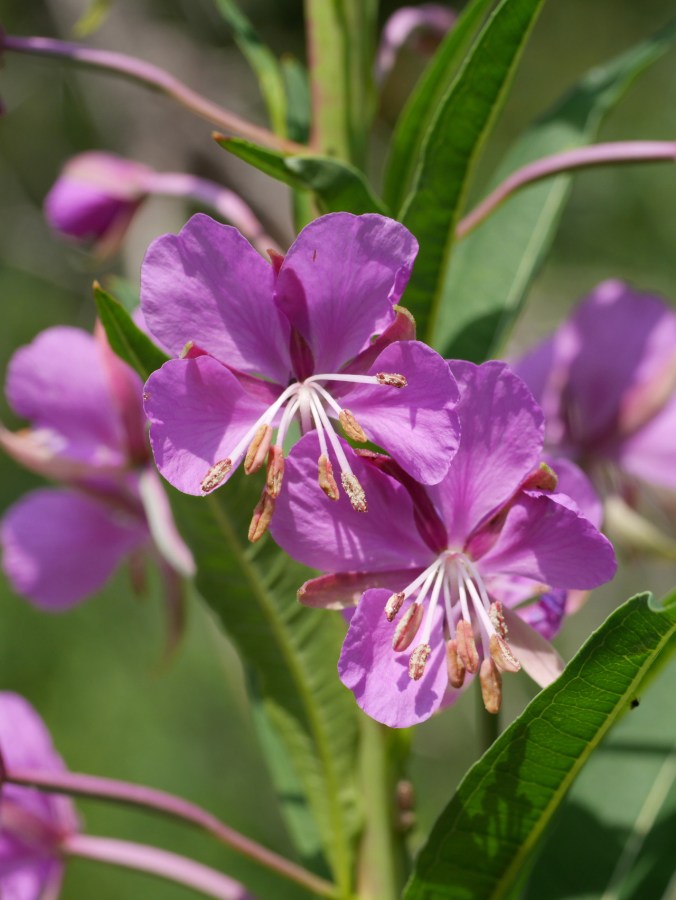
Chamerion (Epilobium) angustifolium “Fireweed” Onagraceae

Great Burn, Lolo National Forest, MT
July 10, 2015
Robert Niese


Unlike its name suggests, Fireweed is hardly a weed! One of the PNW’s most abundant wildflowers, Fireweed holds an important role in nearly every native culture. Its young shoots and leaves are a delicacy to some, and medicinally important to others. Many peoples used fibers torn from its shoots to make rope, and, still today, folks throughout the northern hemisphere use its fluffy seeds as a natural stuffing for pillows.

Anatis rathvoni “Rathvon’s Giant Lady Beetle” Coccinellidae

Great Burn, Lolo National Forest, MT
July 10, 2015
Robert Niese

These massive (10mm) ladybugs are endemic to the PNW and are normally found in pines and other conifers where they voraciously consume aphids, caterpillars, and other small, fleshy-bodied herbivores. Their elytra vary in color from yellow, pale brown, to brown-red, darkening with age. Rathvon’s Giant Ladybird Beetles are named for a relatively obscure 19th century entomologist, S. S. Rathvon from Pennsylvania, who was one of North America’s first entomologists dedicated to educating the public about their local beneficial and pest-insects. Learn more about his life here.

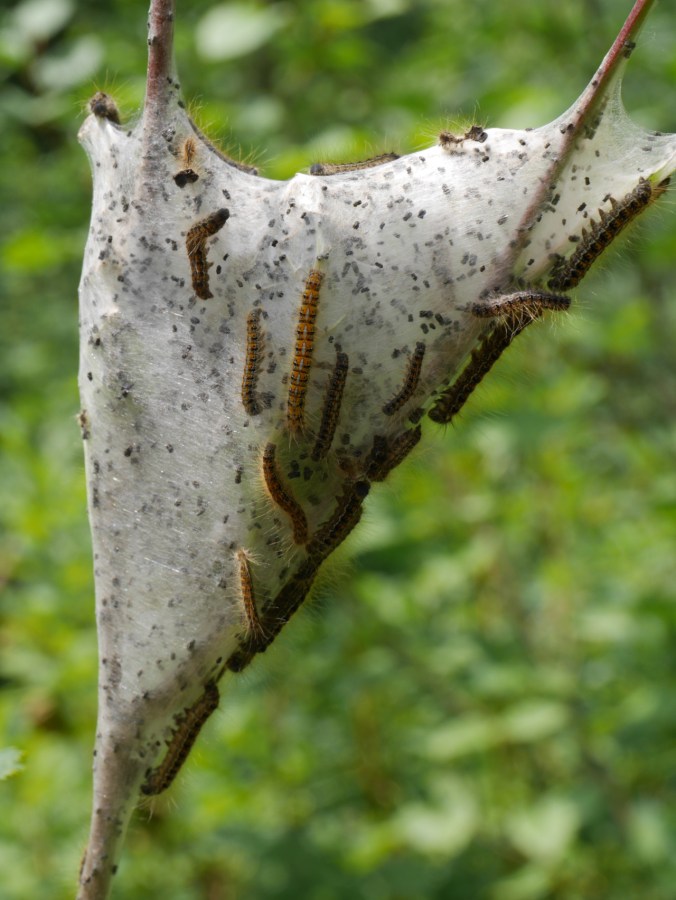
Malacosoma californica “Western Tent Caterpillar” Lasiocampidae

Great Burn, Lolo National Forest, MT
July 10, 2015
Robert Niese

Tent caterpillars are really fascinating critters! In some years, populations of tent caterpillars explode and entire forests can be defoliated by these voracious animals. Fortunately, this extensive herbivory does will not kill most trees, although some eastern forests have experienced large-scale tree deaths when tent caterpillar outbreaks coincided with drought. This year, tent caterpillars have been in relatively low numbers. Learn more about these awesome moths here!

Happy National Moth Week!

Gnophaela vermiculata “Police-car Moth” Arctiidae (now Erebidae)

Great Burn, Lolo National Forest, MT
July 10, 2015
Robert Niese

Here’s another intimate moment between two Police-car Moths from my backpacking trip the other weekend. They really were copulating everywhere. The males will carry their partners through the forest as they both continue to feed on nectar. Eventually they will detach and the female will seek out a Bluebells plant (Mertensia) or some other member of Boraginaceae to lay her eggs.

Happy National Moth Week!

Gnophaela vermiculata “Police-car Moth” Arctiidae (now Erebidae)

Great Burn, Lolo National Forest, MT
July 10, 2015
Robert Niese

The Police-car Moth had a really big year this summer. During our weekend backpacking trip, we must have seen 30 or 40 individuals! These day-flying moths are found in the Northwest, south to Nevada and New Mexico. They tend to be found at mid- to high-elevations in the middle of summer when meadow plants are in full bloom. The adults feed on nectar and copulate for their month-long lives before laying their eggs on any number of Boraginaceae plants (bluebells, houndstongue, Lithospermum, etc.). The larvae will then hatch and eat like crazy until they hibernate as caterpillars, waiting for snows to melt. These two individuals were just hanging out and happily permitted me to photograph their – ahem – intimate moment.

Happy National Moth Week!

Gnophaela vermiculata “Police-car Moth” Arctiidae (now Erebidae)

Great Burn, Lolo National Forest, MT
July 10, 2015
Robert Niese

The Police-car Moth had a really big year this summer. During our weekend backpacking trip, we must have seen 30 or 40 individuals! These day-flying moths are found in the Northwest, south to Nevada and New Mexico. They tend to be found at mid- to high-elevations in the middle of summer when meadow plants are in full bloom. The adults feed on nectar and copulate for their month-long lives before laying their eggs on any number of Boraginaceae plants (bluebells, houndstongue, Lithospermum, etc.). The larvae will then hatch and eat like crazy until they hibernate as caterpillars, waiting for snows to melt. This individual is a male, just about to take flight in search of an unmated female.

Happy National Moth Week!
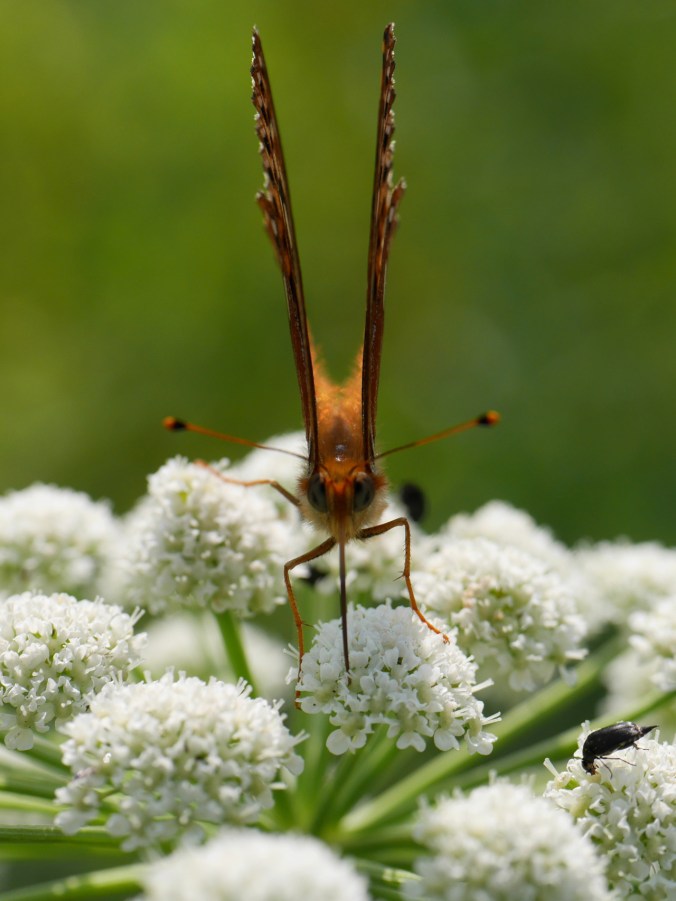
Gnophaela vermiculata “Police-car Moth” Arctiidae (now Erebidae)

Great Burn, Lolo National Forest, MT
July 10, 2015
Robert Niese

The Police-car Moth had a really big year this summer. During our weekend backpacking trip, we must have seen 30 or 40 individuals! These day-flying moths are found in the Northwest, south to Nevada and New Mexico. They tend to be found at mid- to high-elevations in the middle of summer when meadow plants are in full bloom. The adults feed on nectar and copulate for their month-long lives before laying their eggs on any number of Boraginaceae plants (bluebells, houndstongue, Lithospermum, etc.). The larvae will then hatch and eat like crazy until they hibernate as caterpillars, waiting for snows to melt. This individual is a female and will probably be accosted by a hot-and-ready male at any moment.

Happy National Moth Week!

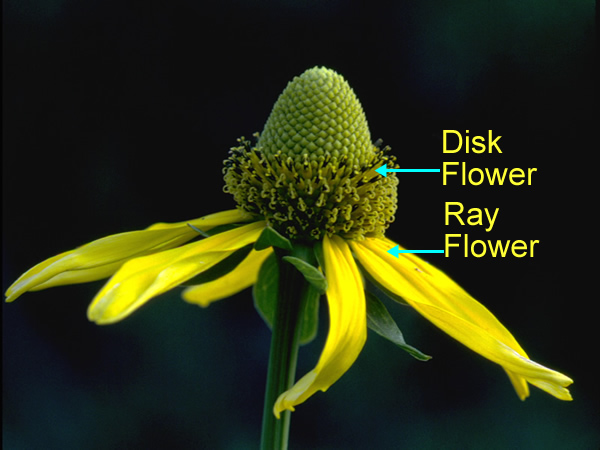
Rudbeckia occidentalis “Western Coneflower” Asteraceae

Great Burn, Lolo National Forest, MT
July 10, 2015
Robert Niese

While most coneflowers that are grown in gardens tend to have showy, petal-like ray flowers, these PNW endemics have only disc flowers. The Western Coneflower is an uncommon resident of moist meadows and valleys in the Northwest and has a very scattered distribution throughout our region. When you do stumble across a population of them, however, they tend to be in great abundance. During our weekend of backpacking in the Bitterroots, these flowers were only just beginning to bloom, and I suspect that most will be done blooming within the week.

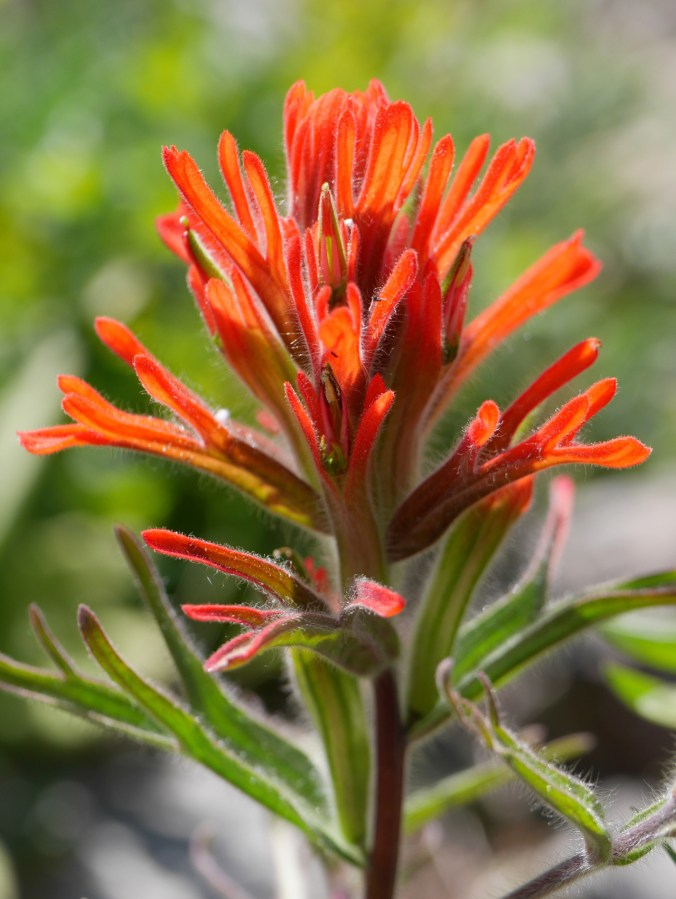
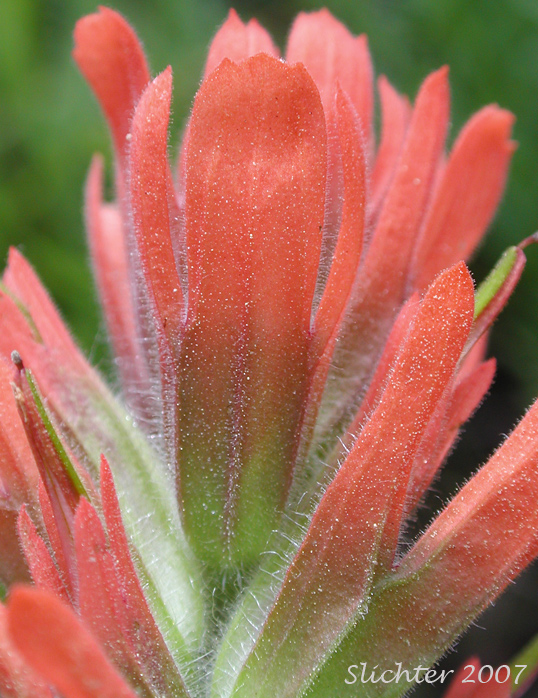
Castilleja hispida “Harsh Paintbrush” Orobanchaceae

Lolo National Forest, Bitterroot Mountains, MT
May 10, 2015
Robert Niese

There are three or four species of paintbrushes with red bracts in the Pacific Northwest. The two most common are the Harsh Paintbrush (C. hispida) and the Common Crimson Paintbrush (C. miniata). C. hispida has a dense coat of long, hispid hairs (which look lovely when back-lit!) and will always have lobed leaves on the upper third of their stems. Conversely C. miniata is often less hairy and will have unlobed leaves on the entire stem (sometimes with small lobes on the upper-most portion). The two can also be differentiated by their calyces which are pointed in C. miniata and blunt in C. hispida.
Fun Fact: All paintbrush species are parasites, growing on the roots of other plants to survive.