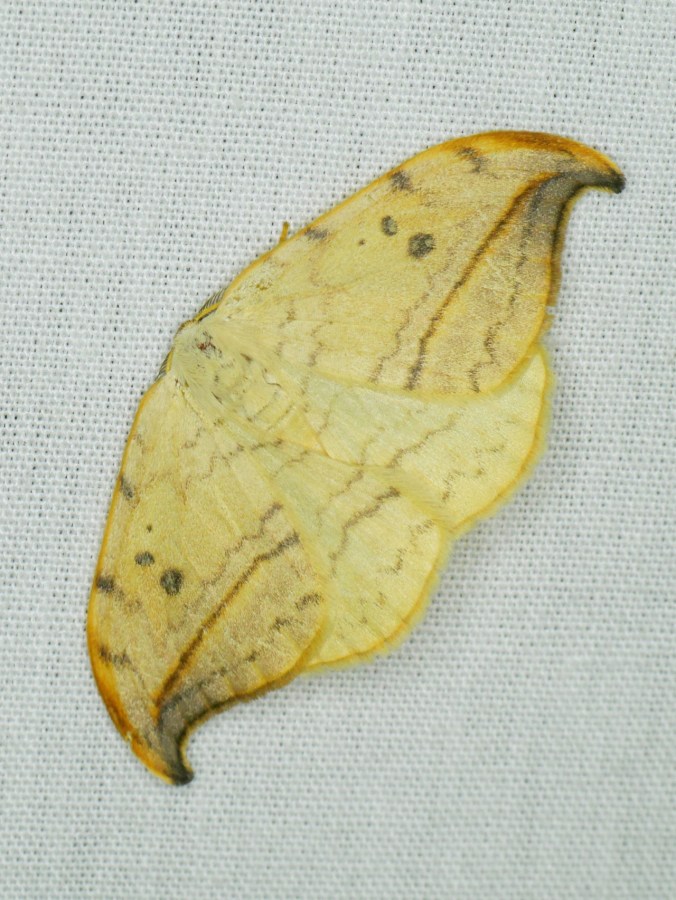
Drepana arcuata “Arched Hooktip Moth” Drepanidae

Clinton, MT
July 25, 2015
Robert Niese


Here’s another moth we spotted during our Mothlighting event for

National Moth Week with the Missoula Butterfly House. These moths are positively unmistakable! In our area there are no other moths that pull-off the “I’m a dead leaf” look quite as well as the Hooktips. The PNW is home to two species of Hooktip moths – D. arcuata and D. bilineata (which, as its name suggests, has two lines instead of one). As larva, Hooktip moths feed on the leaves of Alder and Birch trees where they hide inside folded leaves.

Apache degeeri “Derbid planthopper” Derbidae

Clinton, MT
July 25, 2015
Robert Niese

This little creature looks like something from another planet! Derbid planthoppers are one of entomology’s lesser studied groups of organisms. This particular genus has two members, A. degeeri and A. californicum, and is only found in North America (unlike most planthoppers which tend to be more highly represented in the tropics). This species occurs throughout North America, but tends to be more abundant in the east, while A. californicum is endemic to California. The larvae of these bugs are believed to feed off the hyphae (like roots) of fungi, while adults feed on the sap of trees like Beach, Oak, Maple, and Hickory.

Malacosoma californica “Western Tent Caterpillar Moth” Lasiocampidae

Clinton, MT
July 25, 2015
Robert Niese

Tent caterpillar moths were some of our most abundant visitors during our Mothlighting event for National Moth Week with the Missoula Butterfly House. They are positively adorable as adults, wouldn’t you agree? In our area, we tend to have mostly Western Tent Caterpillars, but we do also get Forest Tent Caterpillars (M. disstria). Caterpillars of M. disstria tend to have broader blue dorsal bands, keyhole-shaped white dorsal spots, and whiter tufts of lateral hairs than M. californica, which, in our area, tend to have more yellow than blue

(however, farther east they tend to lack yellow entirely)

and tend to have dash-shaped white dorsal spots. Adults are far more difficult to distinguish, but in general, M. californica tends to have two lighter-colored lateral bands on its forewings in addition to dark bands, while M disstria tends to lack these bands and only has dark bands. But from the underside, they all just look like teddy bears.