Spiraea densiflora (splendens) “Subalpine Spiraea” Rosaceae

Great Burn, Lolo National Forest, MT
July 10, 2015
Robert Niese


This species of Spiraea is a popular garden plant thanks to beautiful, fragrant pom-pom inflorescences. In the wild, it commonly inhabits moist, rocky slopes throughout the PNW. If you’d like to propagate your own, check out these instructions for collecting and germinating seeds.

Malacosoma californica “Western Tent Caterpillar Moth” Lasiocampidae

Clinton, MT
July 25, 2015
Robert Niese

Tent caterpillar moths were some of our most abundant visitors during our Mothlighting event for National Moth Week with the Missoula Butterfly House. They are positively adorable as adults, wouldn’t you agree? In our area, we tend to have mostly Western Tent Caterpillars, but we do also get Forest Tent Caterpillars (M. disstria). Caterpillars of M. disstria tend to have broader blue dorsal bands, keyhole-shaped white dorsal spots, and whiter tufts of lateral hairs than M. californica, which, in our area, tend to have more yellow than blue

(however, farther east they tend to lack yellow entirely)

and tend to have dash-shaped white dorsal spots. Adults are far more difficult to distinguish, but in general, M. californica tends to have two lighter-colored lateral bands on its forewings in addition to dark bands, while M disstria tends to lack these bands and only has dark bands. But from the underside, they all just look like teddy bears.

Mentha arvensis “Wild Mint” Lamiaceae

Missoula, MT
July 19, 2015
Robert Niese

Mint is one of the most abundant, easily recognizable plants growing along the banks of Missoula’s rivers this summer – perfect for those on-the-fly, riverside mojitos! Look for its square stems, axillary flowers, and minty aroma!

Octopus rubescens “Pacific Red Octopus” Cephalopoda

Oregon Coast Aquarium, Newport, OR
June 12, 2015
Robert Niese


The Pacific Northwest inter- and subtidal zones are home to two species of octopus. O. rubescens is by far the most commonly encountered cephalopod in tidepools along the coast, although, in some regions of Washington, the Giant Pacific Octopus is more abundant. Unlike the somewhat terrifying Giant Pacific Octopus which can reach an arm-spread of over 9m (30ft) and can weigh up to 275kg (600lb), the Red Octopus rarely reaches an arm spread of more than 50cm and is a much more dainty and adorable octopus. Its preferred foods are crustaceans such as hermit crabs, shore crabs, and prawns and, as such, are often accidentally captured in crab and shrimp traps. Be warned, in spite of their adorable, smushy appearance, Red Octopuses are rather strong and really like to bite!

Ceutorhynchus erysimi “Shepherd’s Purse Weevil” Curculionidae

Missoula, MT
June 19, 2015
Robert Niese

These adorable weevils were introduced along with the invasive weed, Shepherd’s Purse (Capsella bursa-pastoris; Brassicaceae) from Europe. They have iridescent green-blue elytra and rarely reach a size of more than 2mm. They’re my new favorite introduced species.

Heerman’s Gull (Larus heermani) Laridae

Yaquina Head Outstanding Natural Area (BLM), OR
June 12, 2015
Robert Niese

Heerman’s Gulls

are often mistaken for jaegers due to their dark, pointed wings and their habit of chasing other birds (particularly pelicans) to steal their prey. They are the only gull species in North America to breed south of the States, but spend winters north of Mexico. Recently, perhaps due to a surge in southern populations thanks to Mexico’s increased protection for the species, a few individuals have attempted to nest in the US on Alcatraz Island.

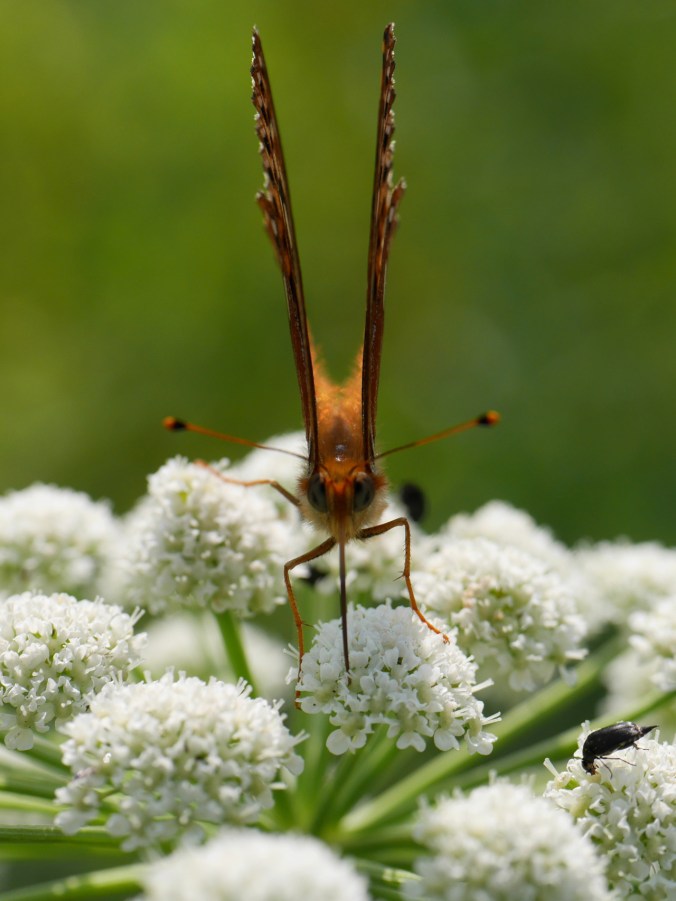
Speyeria hydaspe “Hydaspe Fritillary” Nymphalidae

Great Burn, Lolo National Forest, MT
July 10, 2015
Robert Niese


Fritillaries are common residents of moist meadows throughout North America. They lay their eggs on a variety of violet species. Upon hatching, the larvae immediately burrow into the ground (before eating) and hibernate until spring when they emerge and munch on the violet leaves.

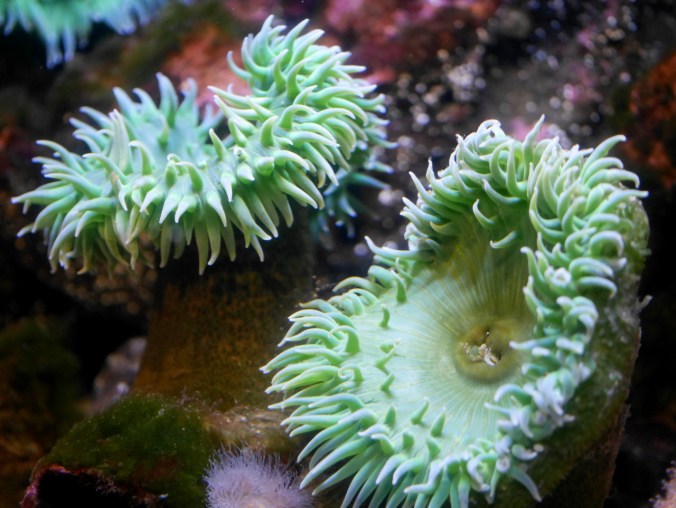
Anthopleura xanthogrammica “Giant Green Anemone” Anthozoa

Oregon Coast Aquarium, Newport, OR
June 12, 2015
Robert Niese


These anemones can grow up to a foot tall and a foot across! They’re abundant on rocky and sandy shores throughout the north-eastern Pacific (from Alaska to Panama). They tend to occur lower in the intertidal zone than their little, pink counterparts (A. elegantissima). The Giant Green Anemone primarily consumes dislodged mussels, crabs, small fish, and urchins, but has been recorded consuming larger animals including baby birds! It’s primary predators are leather stars, snails, and the shaggy mouse nudibranch.

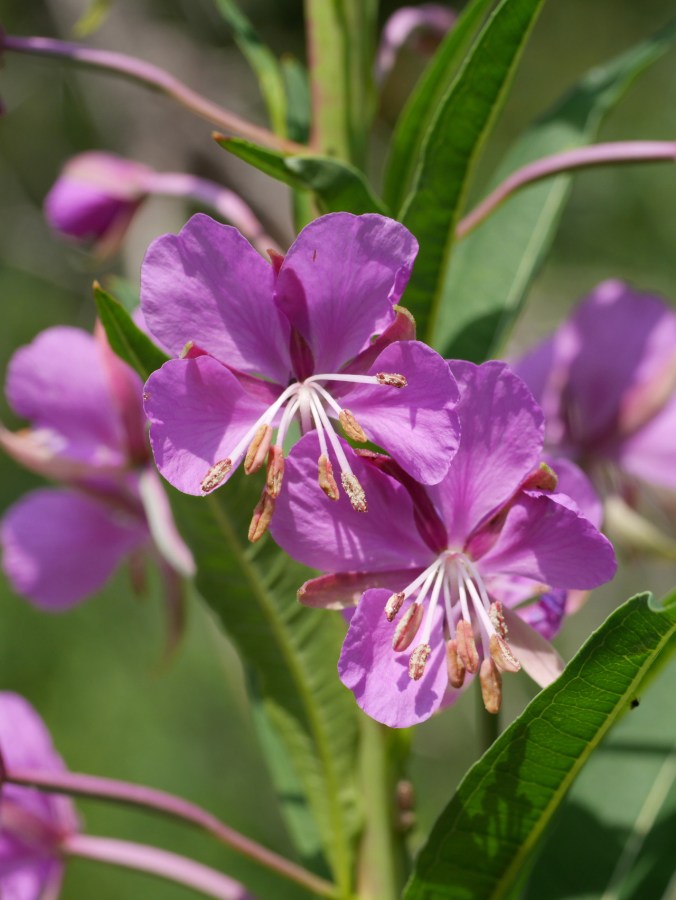
Chamerion (Epilobium) angustifolium “Fireweed” Onagraceae

Great Burn, Lolo National Forest, MT
July 10, 2015
Robert Niese


Unlike its name suggests, Fireweed is hardly a weed! One of the PNW’s most abundant wildflowers, Fireweed holds an important role in nearly every native culture. Its young shoots and leaves are a delicacy to some, and medicinally important to others. Many peoples used fibers torn from its shoots to make rope, and, still today, folks throughout the northern hemisphere use its fluffy seeds as a natural stuffing for pillows.

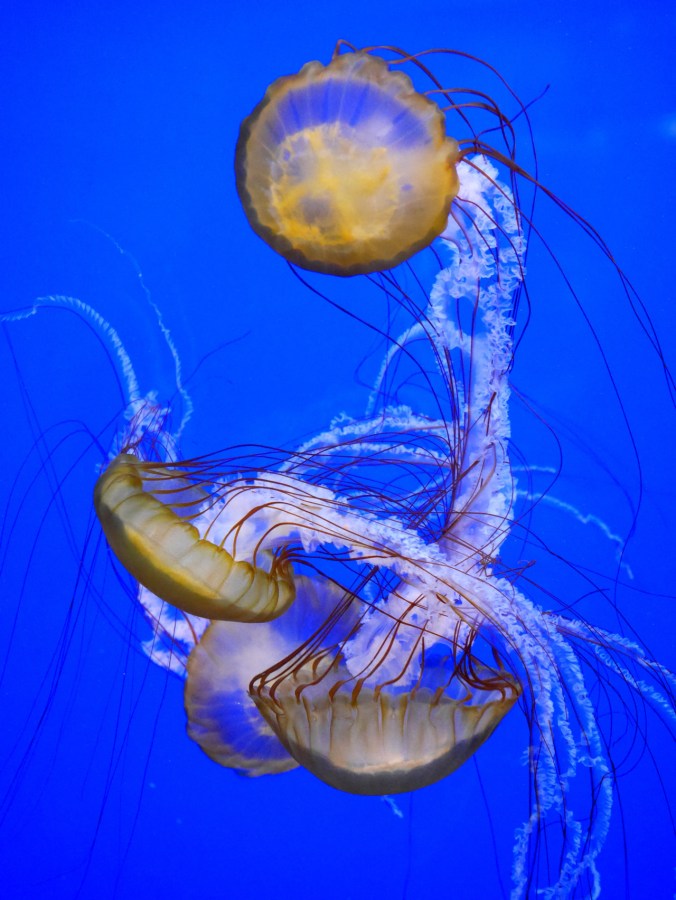
Chrysaora fuscescens “Pacific Sea Nettle” Scyphozoa

Oregon Coast Aquarium, Newport, OR
June 12, 2015
Robert Niese


The Pacific Sea Nettle is a relatively common sea jelly along North America’s Pacific Coast. They are also commonly kept in captivity due to their relatively simple care and attractive coloration. The tentacles of this species can easily grow up to 5 meters long, but are specialized for capturing small zooplankton and are relatively harmless to humans. These sea nettles have been increasing in abundance along the coasts of Oregon for the past few years. It’s possible that rising global sea temperatures or other anthropogenic changes to the local environment are the cause of this drastic increase in nettle populations.