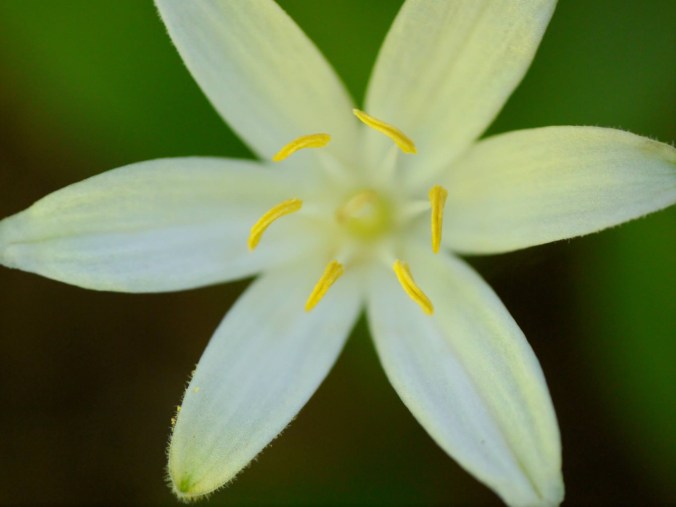
Clintonia uniflora “Queen’s Cup” Liliaceae

Olympic National Park, WA
June 5, 2013
Robert Niese

In spring, these plants bear a single white flower and regularly pop up in fields throughout the moist PNW understory. In the fall, the flowers will turn into blue berries which are mildly poisonous to humans, but are a favorite food of the Ruffed Grouse.

Mitella (Ozomelis) stauropetala “Smallflower Miterwort” Saxifragaceae

Lolo National Forest, Bitterroot Mountains, MT
May 10, 2015
Robert Niese

Chiefly found east of the Cascades, the Smallflower Miterwort is a common resident of moist, dense forests of the Pacific Northwest. Up to 35 flowers grow on leafless stems from a rosette of palmately lobed leaves.

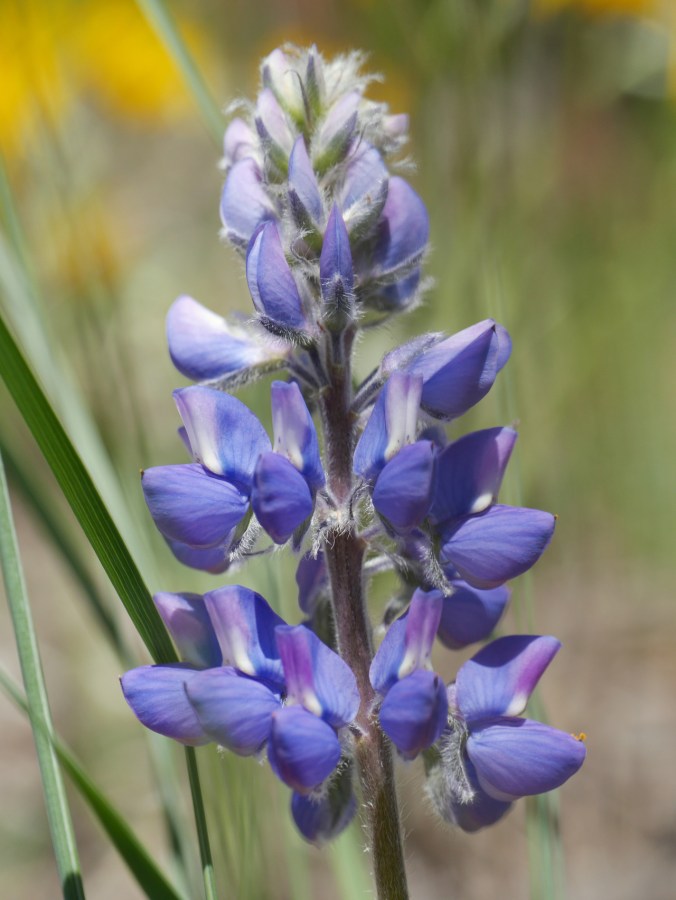
Lupinus argenteus var. argenteus “Silvery Lupine” Fabaceae

Lolo National Forest, Bitterroot Mountains, MT
May 10, 2015
Robert Niese

Our two most common Lupines in the Missoula area are the Silvery and Silky Lupines (L. argenteus and L. sericeus, respectively). You can easily tell them apart by the upper petals on their flowers (called the “banner” in papilionaceous pea flowers). In the Silvery Lupine (pictured here), the backside of the banner has no hairs, while the Silky Lupine has a dense coating of hair on its banners. In our area, Silvery Lupines that grow in the dry soils of Ponderosa Pinelands and have folded leaflets are of the var. argenteus.

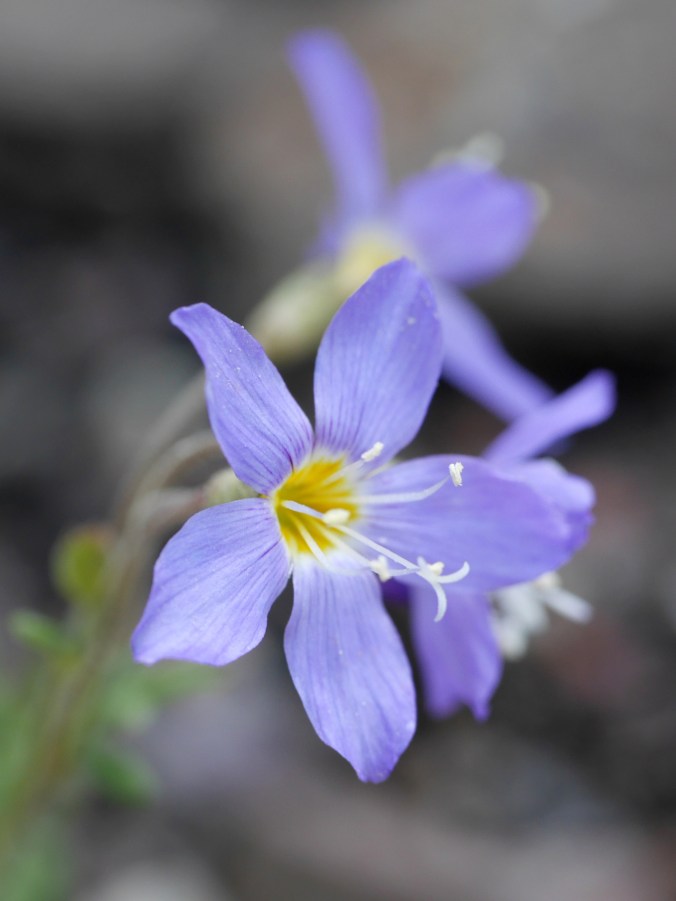
Polemonium pulcherrimum var. pulcherrimum “Jacob’s Ladder” Polemoniaceae

Missoula, MT
April 25, 2015
Robert Niese

Jacob’s Ladder is an abundant wildflower found on talus slopes or rocky outcrops throughout lower elevations of western Montana. However, in Washington, these plants, while equally common, are restricted to sub-alpine zones and are regularly found above the tree-line.

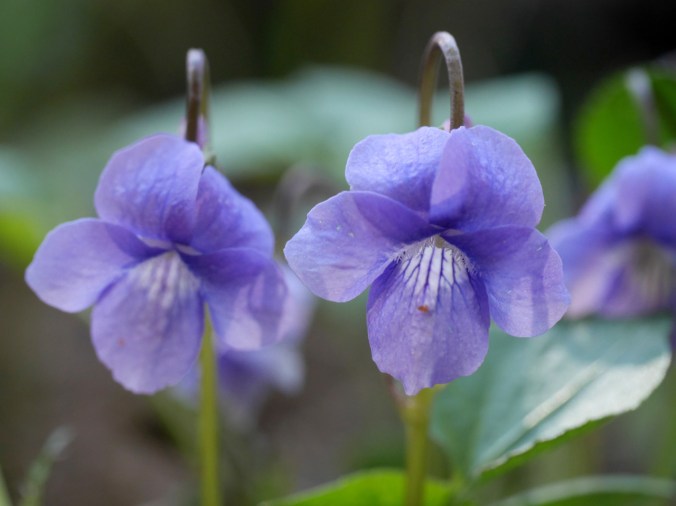
Viola adunca “Hookedspur Violet” Violaceae

Lolo National Forest, Bitterroot Mountains, MT
May 10, 2015
Robert Niese

The Hookedspur Violet is an abundant, easily recognized flower found throughout the Northwest. In our area it is readily distinguished from other purple-flowered violets by its long spur (not shown here) and its lance-ovate or near-cordate-ovate leaves. 

Ribes lacustre “Spiny Swamp Currant” Grossulariaceae

Lolo National Forest, Bitterroot Mountains, MT
May 10, 2015
Robert Niese

East of the Cascades, the Spiny Swamp Currant is the most common member of Ribes in shady, wet areas of dense coniferous forests. Their berries, like most Ribes are edible but quite unpalatable. 

Arnica cordifolia “Heart-leaf Arnica” Asteraceae

Lolo National Forest, Bitterroot Mountains, MT
May 10, 2015
Robert Niese

These lovely flowers are literally blanketing the otherwise barren burn areas of the Lolo National Forest this year!

Misumena vatia “Goldenrod Crab Spider” Thomisidae on
Cymopterus glaucus “Waxy Spring Parsley” Apiaceae

Lolo National Forest, Bitterroot Mountains, MT
May 10, 2015
Robert Niese

Goldenrod Crab Spiders are inordinately abundant in spring blooms all around the PNW. They can be differentiated from their cousins in the genus Misumenoides by the lack of a faint white ridge on their face between their lower eyes and their jaws. But far more interesting than this lurking ambush predator is the fact that this image of Cymopterus glaucus is the first to grace the internet. And all because I thought I was taking a picture of a cool spider. You can see more photos of this plant below. C. glaucus is endemic to Idaho and western Montana where it is locally common on sandy or gravely slopes in dry Ponderosa Pinelands. I’m so confounded by the lack of images of this plant online that I’ll be checking out the UM herbarium later to verify that this is indeed C. glaucus. Any suggestions to the contrary would be much appreciated.

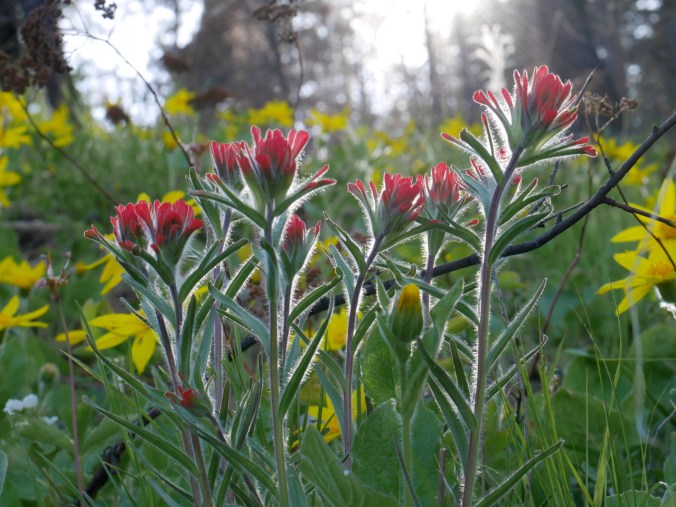
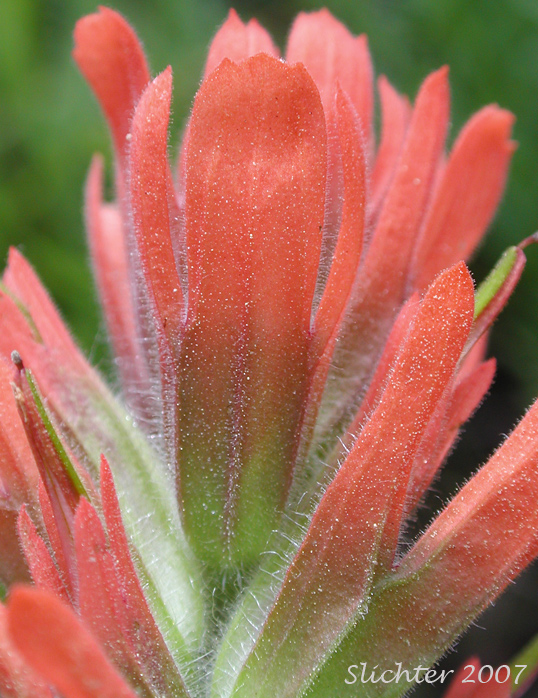
Castilleja hispida “Harsh Paintbrush” Orobanchaceae

Lolo National Forest, Bitterroot Mountains, MT
May 10, 2015
Robert Niese

There are three or four species of paintbrushes with red bracts in the Pacific Northwest. The two most common are the Harsh Paintbrush (C. hispida) and the Common Crimson Paintbrush (C. miniata). C. hispida has a dense coat of long, hispid hairs (which look lovely when back-lit!) and will always have lobed leaves on the upper third of their stems. Conversely C. miniata is often less hairy and will have unlobed leaves on the entire stem (sometimes with small lobes on the upper-most portion). The two can also be differentiated by their calyces which are pointed in C. miniata and blunt in C. hispida.
Fun Fact: All paintbrush species are parasites, growing on the roots of other plants to survive.

Erodium cicutarium “Stork’s Bill” Geraniaceae

Missoula, MT
April 23, 2015
Robert Niese

Erodium is famous for its fascinating dispersal mechanism. Their fruits are shaped like a stork’s bill (hence the common name) and separate into five seeds with a wirey tip upon maturity. As the seeds dry out, they begin to curl up into a corkscrew-like shape. If they are resting on soil as they begin to dry, this curling process will drive them into the ground. You can watch this self-planting mechanism here or check out the GIF below. It’s really freaking awesome!