Agapeta zoegana “Sulphur Knapweed Moth” Tortricidae

August 14, 2014
Missoula, MT
Robert Niese

These diminutive moths (10mm in length) are obligate parasites of our invasive knapweed (Centaurea maculosa) and were introduced in 1984 as a potential biological control agent.

Happy National Moth Week!

Choristoneura rosaceana “Oblique-banded Tortrix Leafroller” Tortricidae

Point Defiance Park, Tacoma, WA
July 22, 2013
Robert Niese

The larva of these inconspicuous moths are significant pests on apples (and many other rosaceous plants) where they voraciously consume both fruits and leaves. Larval leafrollers, as their name suggests, roll-up the leaves of their host plants and hide inside the rolled-up tube for protection from parasites and predators. Learn more about this species at the Colorado State University’s interactive webpage on Tortricids of Agricultural Importance.

Happy National Moth Week!

Gnophaela vermiculata “Police-car Moth” Arctiidae (now Erebidae)

Great Burn, Lolo National Forest, MT
July 10, 2015
Robert Niese

The Police-car Moth had a really big year this summer. During our weekend backpacking trip, we must have seen 30 or 40 individuals! These day-flying moths are found in the Northwest, south to Nevada and New Mexico. They tend to be found at mid- to high-elevations in the middle of summer when meadow plants are in full bloom. The adults feed on nectar and copulate for their month-long lives before laying their eggs on any number of Boraginaceae plants (bluebells, houndstongue, Lithospermum, etc.). The larvae will then hatch and eat like crazy until they hibernate as caterpillars, waiting for snows to melt. These two individuals were just hanging out and happily permitted me to photograph their – ahem – intimate moment.

Happy National Moth Week!

Gnophaela vermiculata “Police-car Moth” Arctiidae (now Erebidae)

Great Burn, Lolo National Forest, MT
July 10, 2015
Robert Niese

The Police-car Moth had a really big year this summer. During our weekend backpacking trip, we must have seen 30 or 40 individuals! These day-flying moths are found in the Northwest, south to Nevada and New Mexico. They tend to be found at mid- to high-elevations in the middle of summer when meadow plants are in full bloom. The adults feed on nectar and copulate for their month-long lives before laying their eggs on any number of Boraginaceae plants (bluebells, houndstongue, Lithospermum, etc.). The larvae will then hatch and eat like crazy until they hibernate as caterpillars, waiting for snows to melt. This individual is a male, just about to take flight in search of an unmated female.

Happy National Moth Week!

Gnophaela vermiculata “Police-car Moth” Arctiidae (now Erebidae)

Great Burn, Lolo National Forest, MT
July 10, 2015
Robert Niese

The Police-car Moth had a really big year this summer. During our weekend backpacking trip, we must have seen 30 or 40 individuals! These day-flying moths are found in the Northwest, south to Nevada and New Mexico. They tend to be found at mid- to high-elevations in the middle of summer when meadow plants are in full bloom. The adults feed on nectar and copulate for their month-long lives before laying their eggs on any number of Boraginaceae plants (bluebells, houndstongue, Lithospermum, etc.). The larvae will then hatch and eat like crazy until they hibernate as caterpillars, waiting for snows to melt. This individual is a female and will probably be accosted by a hot-and-ready male at any moment.

Happy National Moth Week!

Paonias excaecata “Blinded Sphinx” Sphingidae

Lewis and Clark Trail State Park, WA
June 9, 2015
Robert Niese

These relatively large sphinx moths are quite common throughout the PNW. Their unusual, scalloped forewings are definitely beautiful, but their most striking feature is certainly their hindwings which possess startlingly prominent eyespots. Sorry I couldn’t get a photo of them for you though. Check out this unhappy individual here instead. Look for them around light sources near riparian, mixed-hardwood forests this summer!

Be sure to participate in National Moth Week July 18-26! To find events near you, check out their webpage! This year, we’re focusing on the Sphingids like this guy here!

Pollicipes polymerus “Gooseneck Barnacle” Cirripedia (Crustacea)

Seal Rock State Park, OR
June 11, 2015
Robert Niese

This species of Gooseneck Barnacle is the most common species of intertidal goosenecks in the PNW. In Portugal and Spain, their cousin P. pollicipes, is a common delicacy, but due to over-harvesting and coastline habitat destruction, the PNW now regularly exports this species to Europe. Check out Gordon Ramsey preparing a traditional, tapas-style barnacle recipe here. Also, this species is in direct competition for space and resources with California Mussels (Mytilus californianus) and will out-compete them in the absence of their primary predators, the Ochre Sea Star (Pisaster ochraceous) and the Glaucous-winged Gull (Larus glaucescens).

Eleodes “Desert Stink Beetle” Tenebrionidae

Palouse Falls State Park, WA
June 8, 2015
Robert Niese

Stink beetles are very common throughout the sagebrush deserts of eastern Washington. The Tenebrionid family’s taxonomy is extremely complex and often requires an examination of female genitalia to identify an organism with any further specificity, but most of the large black species fall into this supergenus. This beetle is posed and ready to release nasty-smelling chemicals in response to my terrifying camera lens. 

Vanessa atalanta “Red Admiral” Nymphalidae

Palouse Falls State Park, WA
June 8, 2015
Robert Niese

This lovely Red Admiral sought refuge on this tree as the wind picked up at Palouse. This is an uncommon view of this species whose common name reflects its bright red markings on its upper surfaces. The Red Admiral also has red markings on its underwings, but keeps them hidden while attempting to camouflage itself as it is doing here.

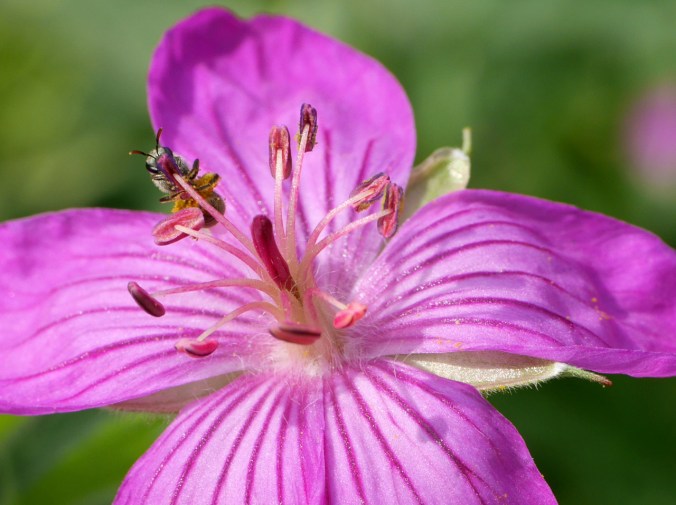
Halictus sp. “Sweat Bee” Halictidae on
Geranium viscosissimum “Sticky Geranium” Geraniaceae

Drinking Horse Mountain, Bozeman, MT
June 3, 2015
Robert Niese

Sticky Geranium, as its name would suggest, is covered in tiny glandular hairs that are quite sticky to the touch. Some have suggested that these sticky glands are capable of capturing and digesting small orgnanisms, making the plant slightly carnivorous. It grows in meadows, Ponderosa Pinelands, and at the edge of sagebrush-steppe habitats throughout the PNW.