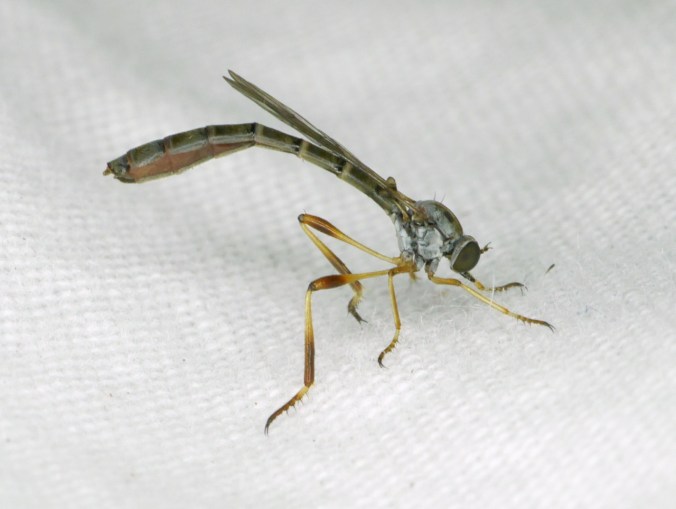
Leptogaster (coloradensis?) “Colorado Slender Robber Fly” Asilidae

Clinton, MT
July 25, 2015
Robert Niese


When we first saw this odd fly on our sheets during our mothlighting event last month, we thought it was a parasitic wasp! Turns out its a Leptogaster robber fly, a group of flies that are very poorly studied. Montana only has records for two species of Leptogaster flies, but it’s possible that several others occur here, and others may still be new to science. Robber flies are the tigers of the insect world and this individual likely joined us at the sheets to partake in a late night snack of gnats and midges.
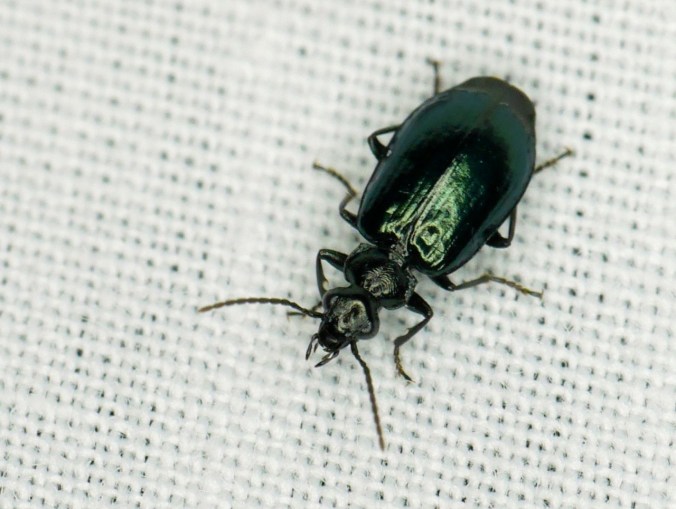
Lebia viridis (cyanipennis) “Western Colorful Foliage Beetle” Carabidae

Clinton, MT
July 25, 2015
Robert Niese

This awesome carnivorous beetle joined us at the sheets during our Mothlighting event for National Moth Week with the Missoula Butterfly House. These colorful Carabids didn’t come to the light looking for sex though. They were on the hunt! This guy was speedily chasing after gnats and other small insects that we had attracted to our lights. In my opinion, watching these tiny predators was just as exciting as any lion hunt in Africa!

Cyphocleonus achates “Knapweed Root Weevil” Curculionidae

Missoula, MT
August 13, 2015
Robert Niese

These weevils are native to Europe, but were introduced in the 1980s as a potential biological control agent for various species of knapweed. Various studies have shown that they are actually quite good at reducing the biomass of Spotted Knapweed, and have been successful in various locations in Montana, Minnesota, Oregon, Nevada, British Columbia, and recently, Michigan.

Balanus nubilus “Giant Acorn Barnacle” Cirripedia (Crustacea)

Oregon Coast Aquarium, Newport, OR
June 12, 2015
Robert Niese

B. nubilus is the world’s largest species of barnacle and can grow up to half a foot across and over a foot tall! This species also holds the world record for having the largest individual muscle fibers of any animal! These fibers are regularly used in the study of muscle physiology. Like all barnacles, this species is a filter feeder and prefers to reside in waters that have constant currents or wave action, but will also grow on the hard shells of other animals. The Giant Acorn Barnacle was first described by Charles Darwin in his lesser-known works on Cirripedes from the 1850s, prior to the publication of the Origin of Species. His research on barnacle anatomy and systematics is recognized as one of the most important works in Cirripede science from the past two centuries, and yet, very few people are aware of his contributions to Crustacea.

Caenurgina erechtea “Forage Looper” Erebidae

Clinton, MT
July 25, 2015
Robert Niese

Here’s another moth we spotted during our Mothlighting event for National Moth Week with the Missoula Butterfly House. This individual didn’t come to light, however. It came to our sugar lick! A sticky goopy paste of sugar, bananas, molasses, and beer can attract some unique nighttime visitors that you wouldn’t normally see at a light! This Forage Looper was far more interested in a sugary snack, than an insect orgy at a blacklight. And check out that camouflage! So neat!

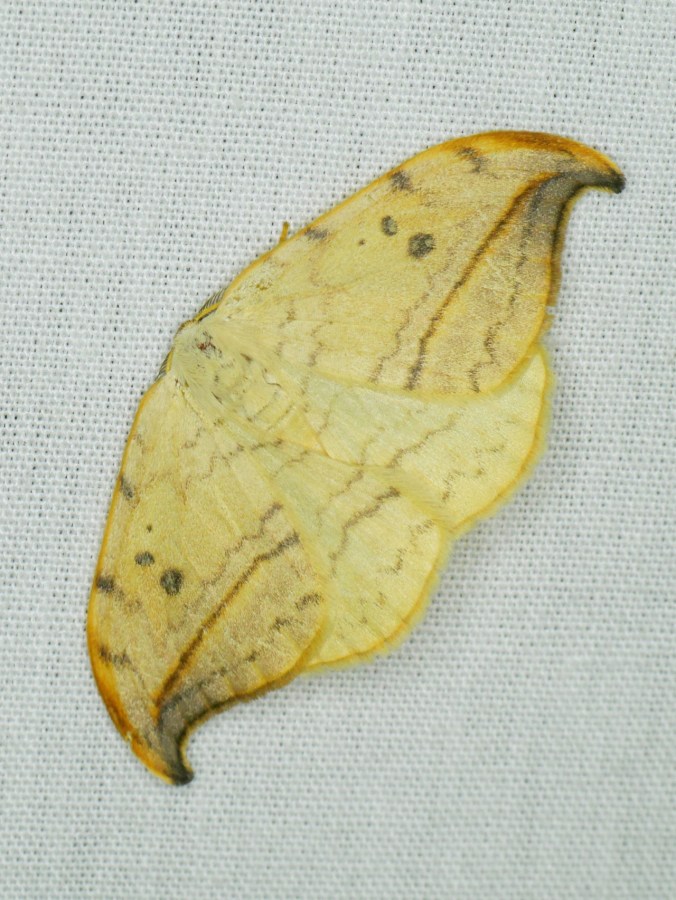
Drepana arcuata “Arched Hooktip Moth” Drepanidae

Clinton, MT
July 25, 2015
Robert Niese


Here’s another moth we spotted during our Mothlighting event for

National Moth Week with the Missoula Butterfly House. These moths are positively unmistakable! In our area there are no other moths that pull-off the “I’m a dead leaf” look quite as well as the Hooktips. The PNW is home to two species of Hooktip moths – D. arcuata and D. bilineata (which, as its name suggests, has two lines instead of one). As larva, Hooktip moths feed on the leaves of Alder and Birch trees where they hide inside folded leaves.

Apache degeeri “Derbid planthopper” Derbidae

Clinton, MT
July 25, 2015
Robert Niese

This little creature looks like something from another planet! Derbid planthoppers are one of entomology’s lesser studied groups of organisms. This particular genus has two members, A. degeeri and A. californicum, and is only found in North America (unlike most planthoppers which tend to be more highly represented in the tropics). This species occurs throughout North America, but tends to be more abundant in the east, while A. californicum is endemic to California. The larvae of these bugs are believed to feed off the hyphae (like roots) of fungi, while adults feed on the sap of trees like Beach, Oak, Maple, and Hickory.

Malacosoma californica “Western Tent Caterpillar Moth” Lasiocampidae

Clinton, MT
July 25, 2015
Robert Niese

Tent caterpillar moths were some of our most abundant visitors during our Mothlighting event for National Moth Week with the Missoula Butterfly House. They are positively adorable as adults, wouldn’t you agree? In our area, we tend to have mostly Western Tent Caterpillars, but we do also get Forest Tent Caterpillars (M. disstria). Caterpillars of M. disstria tend to have broader blue dorsal bands, keyhole-shaped white dorsal spots, and whiter tufts of lateral hairs than M. californica, which, in our area, tend to have more yellow than blue

(however, farther east they tend to lack yellow entirely)

and tend to have dash-shaped white dorsal spots. Adults are far more difficult to distinguish, but in general, M. californica tends to have two lighter-colored lateral bands on its forewings in addition to dark bands, while M disstria tends to lack these bands and only has dark bands. But from the underside, they all just look like teddy bears.

Ceutorhynchus erysimi “Shepherd’s Purse Weevil” Curculionidae

Missoula, MT
June 19, 2015
Robert Niese

These adorable weevils were introduced along with the invasive weed, Shepherd’s Purse (Capsella bursa-pastoris; Brassicaceae) from Europe. They have iridescent green-blue elytra and rarely reach a size of more than 2mm. They’re my new favorite introduced species.

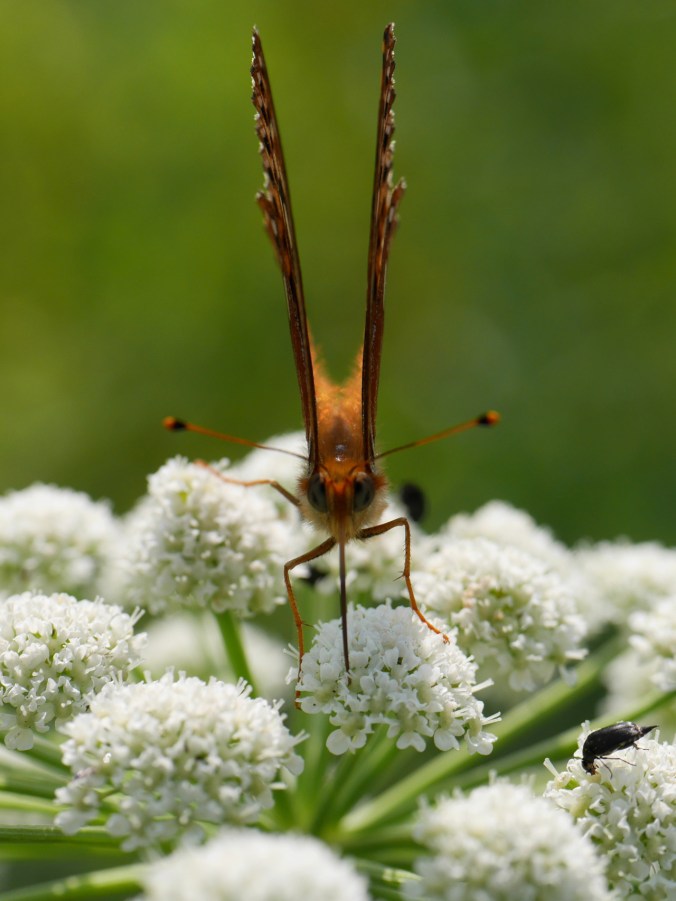
Speyeria hydaspe “Hydaspe Fritillary” Nymphalidae

Great Burn, Lolo National Forest, MT
July 10, 2015
Robert Niese


Fritillaries are common residents of moist meadows throughout North America. They lay their eggs on a variety of violet species. Upon hatching, the larvae immediately burrow into the ground (before eating) and hibernate until spring when they emerge and munch on the violet leaves.