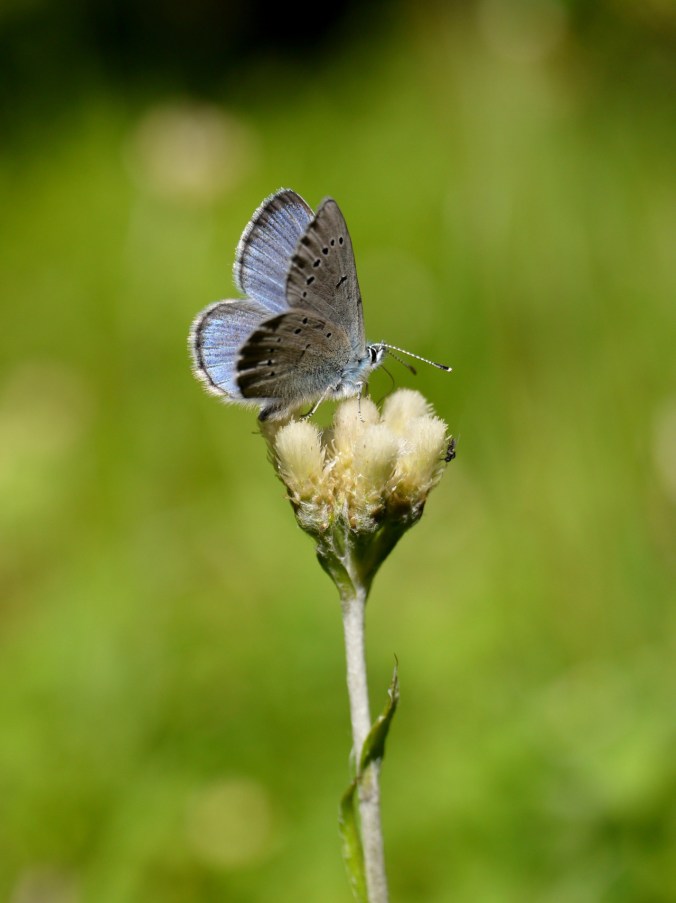
Glaucopsyche lygdamus “Silvery Blue” Lycaenidae

Glacier National Park, MT
June 21, 2014
Robert Niese

As with many members of the Lycaenidae family (blues, coppers, and hairstreaks), the caterpillars of this species are tended by ants which provide the vulnerable larvae with protection in exchange for sugary “honeydew” which the caterpillars excrete from their backs. Check it out.

Graphocephala fennahiRhododendron Leafhopper” Cicadellidae

Tacoma, WA
August 2013
Robert Niese

Apparently, these sharpshooters are native to the south eastern Appalachians, but have since traveled the world in ornamental Rhododendrons. 

Antheraea polyphemus “Polyphemus Moth” Saturniidae (male)

Missoula, MT
June 11, 2014
Robert Niese

Surprisingly, I found this enormous moth (15 cm wingspan!) in a parking lot on my way into work on the University of Montana campus.

Sphecodes (arvensiformis) “Cuckoo Sweat Bee” Halictidae
on Lomatium “Biscuit Root” Apiaceae

Missoula, MT
May 13, 2014
Robert Niese

Sphecodes bees are cleptoparasitic, cuckoo-like bees that lay their eggs in the nests of other sweat bees.

Ectoedemia sericopeza “Norway Maple Seedminer” Nepticulidae

Missoula, MT
September 25, 2014
Robert Niese

These teensy-tiny moths are rarely over 2mm in length and are among some of the smallest lepidopterans in the world. Their larvae, which are equally infinitesimal, feed exclusively on (and within!) the tissues of the Norway Maple (Acer platanoides), an introduced species which lines most of our streets here in Missoula.

Mantis religiosa “European Mantis” Mantidae

Woodinville, WA
August 13, 2013
Robert Niese

Native mantids are exceedingly rare in Washington, but that doesn’t make the introduced and abundant European Mantis any less photogenic. If you’re interested in finding natives, try scouring sagebrush habitats in central Washington for Litaneutria, a small gray ground mantis.