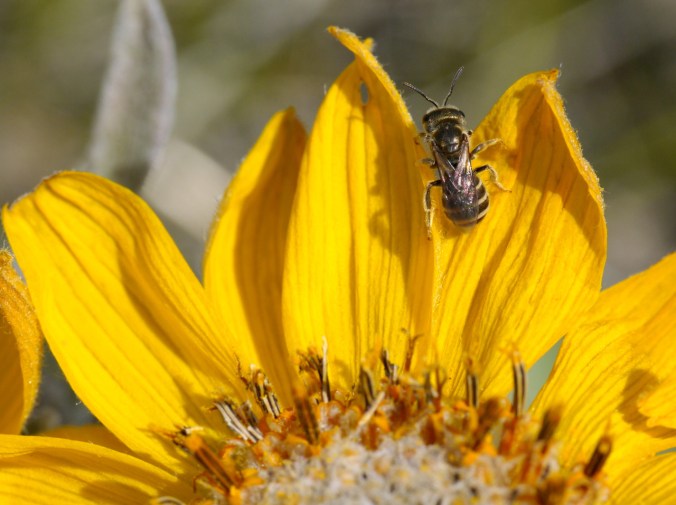
Halictus (Seladonia) tripartitus “Sweat Bee” Halictidae
on Balsamorhiza sagittata “Arrowleaf Balsamroot” Asteraceae

Missoula, MT
May 13, 2014
Robert Niese

Another species of small Sweat Bee in the genus Halictus. If you’re interested in attempting to identify these bees with a dichotomous key (there are only 10 species in the Northwest, so it’s not too difficult!), check this one out here. Once you learn more about these little guys, you start noticing them everywhere!
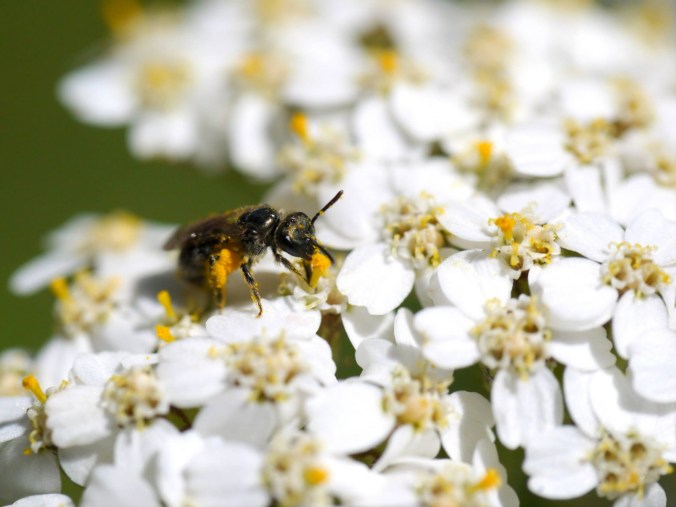
Lasioglossum (Subgenus Dialictus) “Sweat Bee” Halictidae
on Achillea millefolium “Yarrow” Asteraceae

Tacoma, WA
July 6, 2013
Robert Niese

These bees are notoriously difficult to identify. There are more than 290 species in the US and Canada and approximately 1700 species worldwide. Most Sweat Bees (family Halictidae) in our area fall into this mega-Genus. Look for them anywhere and anytime there are flowers blooming. You’re bound to see at least a half dozen species of Halictids on any given summer day!

Apis mellifera “European Honeybee” Apidae 
on Ranunculus glaberrimus “Sagebrush Buttercup” Ranunculaceae

Council Grove State Park, MT
March 16, 2015
Robert Niese

It’s warming up here in Missoula and spring may have sprung early! The first Ranunculus glaberrimus flowers bloomed around town in early February which is several weeks earlier than previous years. Today was even warm enough to bring out a few species of bees like this European Honeybee.

Anoplius sp. “Blue-black Spider Wasps” Pompilidae

Missoula, MT
June 29, 2014
Robert Niese

These lovely wasps are vicious spider hunters and have an absolutely gruesome life cycle. Instead of immediately killing their quarry, females paralyze the spider with a sting, and drag it down into a burrow. There, the female will lay eggs inside the spider, where her young will hatch and feed on the poor arachnid from the inside-out. Interestingly, spider wasps are nectivorous and lose their hunger for arachnid flesh at adulthood.

Sphecodes (arvensiformis) “Cuckoo Sweat Bee” Halictidae
on Lomatium “Biscuit Root” Apiaceae

Missoula, MT
May 13, 2014
Robert Niese

Sphecodes bees are cleptoparasitic, cuckoo-like bees that lay their eggs in the nests of other sweat bees.