Mentha arvensis “Wild Mint” Lamiaceae

Missoula, MT
July 19, 2015
Robert Niese

Mint is one of the most abundant, easily recognizable plants growing along the banks of Missoula’s rivers this summer – perfect for those on-the-fly, riverside mojitos! Look for its square stems, axillary flowers, and minty aroma!

Octopus rubescens “Pacific Red Octopus” Cephalopoda

Oregon Coast Aquarium, Newport, OR
June 12, 2015
Robert Niese


The Pacific Northwest inter- and subtidal zones are home to two species of octopus. O. rubescens is by far the most commonly encountered cephalopod in tidepools along the coast, although, in some regions of Washington, the Giant Pacific Octopus is more abundant. Unlike the somewhat terrifying Giant Pacific Octopus which can reach an arm-spread of over 9m (30ft) and can weigh up to 275kg (600lb), the Red Octopus rarely reaches an arm spread of more than 50cm and is a much more dainty and adorable octopus. Its preferred foods are crustaceans such as hermit crabs, shore crabs, and prawns and, as such, are often accidentally captured in crab and shrimp traps. Be warned, in spite of their adorable, smushy appearance, Red Octopuses are rather strong and really like to bite!

Ceutorhynchus erysimi “Shepherd’s Purse Weevil” Curculionidae

Missoula, MT
June 19, 2015
Robert Niese

These adorable weevils were introduced along with the invasive weed, Shepherd’s Purse (Capsella bursa-pastoris; Brassicaceae) from Europe. They have iridescent green-blue elytra and rarely reach a size of more than 2mm. They’re my new favorite introduced species.

Heerman’s Gull (Larus heermani) Laridae

Yaquina Head Outstanding Natural Area (BLM), OR
June 12, 2015
Robert Niese

Heerman’s Gulls

are often mistaken for jaegers due to their dark, pointed wings and their habit of chasing other birds (particularly pelicans) to steal their prey. They are the only gull species in North America to breed south of the States, but spend winters north of Mexico. Recently, perhaps due to a surge in southern populations thanks to Mexico’s increased protection for the species, a few individuals have attempted to nest in the US on Alcatraz Island.

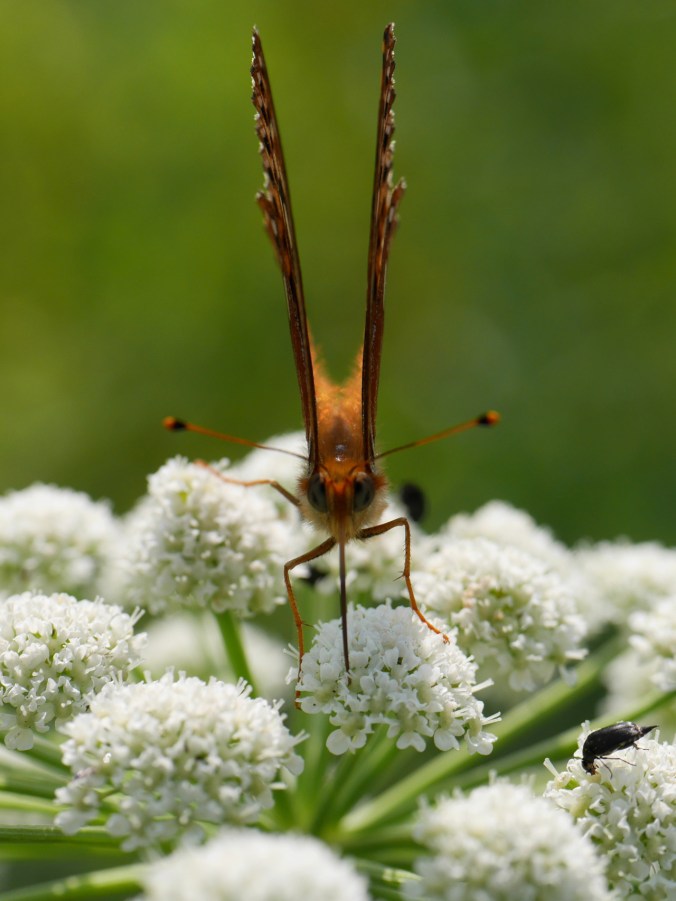
Speyeria hydaspe “Hydaspe Fritillary” Nymphalidae

Great Burn, Lolo National Forest, MT
July 10, 2015
Robert Niese


Fritillaries are common residents of moist meadows throughout North America. They lay their eggs on a variety of violet species. Upon hatching, the larvae immediately burrow into the ground (before eating) and hibernate until spring when they emerge and munch on the violet leaves.